
The short answer
- The mehndi ceremony is a pre-wedding function at which henna is applied to the bride's hands and feet, usually one or two days before the wedding, with music, food and the women of the family.
- Henna darkens for a day or two after the paste comes off, so a mehndi held one or two days before the wedding gives the deepest colour on the wedding day.
- Full bridal designs on the hands and feet can take several hours. Start the bride first and plan the rest of the function around her.
- Book enough artists for the number of guests who want mehndi, and ask each artist how many guests they can cover in the time you have.
- Use only natural henna. So-called black henna can contain PPD, a chemical that can cause severe skin reactions.
- The bride cannot use her hands for hours. Plan food that someone can feed her, and seating she can stay in comfortably.
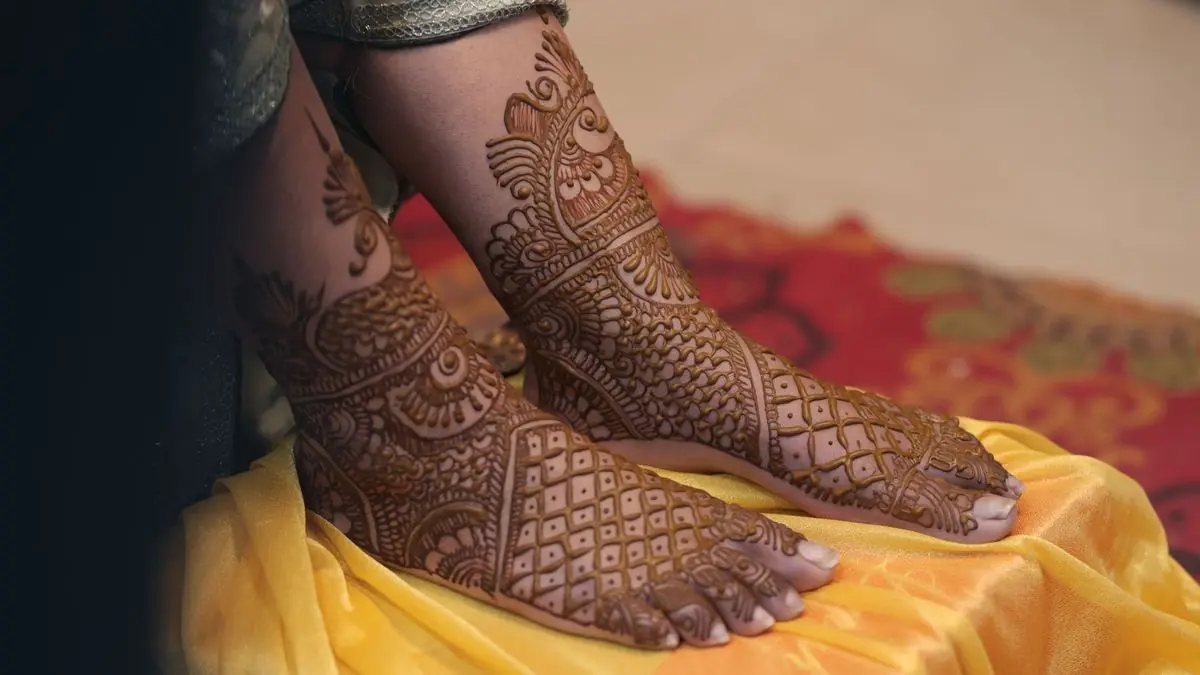
The mehndi ceremony is the pre-wedding function at which henna is applied to the bride's hands and feet. It is usually held one or two days before the wedding, in the afternoon, with music, food and the women of both families, and the guests have mehndi applied too.
It is the most relaxed function of the wedding, but it has one practical constraint the others do not: for several hours, the bride cannot use her hands. Good planning works around that, and around the time the henna needs to darken.
This guide covers what the mehndi means, when to hold it, how long it takes, and then the ideas: decor, seating, food, music and games, with the tips that give the bride a darker colour on the wedding day.
What is the mehndi ceremony?
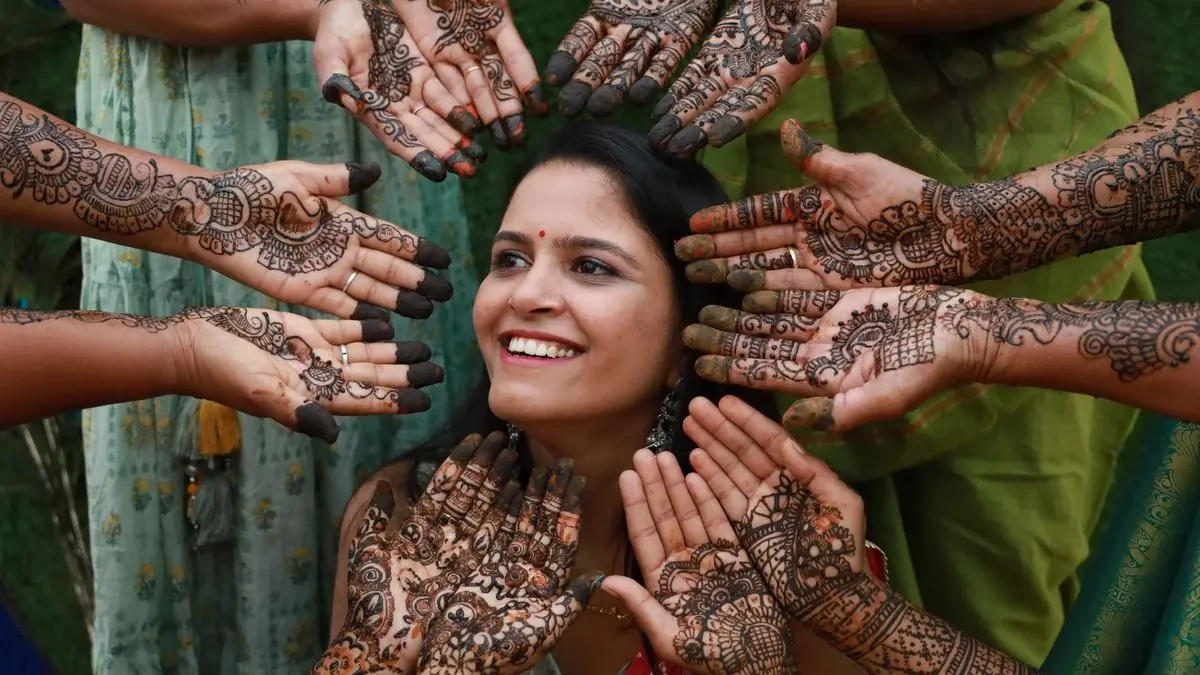
Mehndi is henna, a paste made from the dried leaves of the henna plant. Applied to the skin, it leaves a reddish-brown stain that lasts one to three weeks. In Indian weddings it is applied to the bride in fine patterns, usually covering her hands to the forearms and her feet to the ankles.
The ceremony around it is part ritual and part party. Mehndi is considered auspicious and a sign of joy, and a deep colour is often said to show the strength of the couple's love. Many brides have the groom's name or initials hidden in the design, and he is expected to find it later.
In many families the women sing traditional mehndi songs while the bride sits for her design. The groom usually has a small token mehndi too, at his own function or at a joint one.
When should the mehndi be held?
One or two days before the wedding. Henna keeps darkening for a day or two after the paste is removed, so the colour is deepest on the wedding day if the mehndi is held then. A mehndi on the wedding morning leaves the colour pale for the ceremony.
Many families now hold the haldi in the morning and the mehndi in the afternoon of the same day, followed by the sangeet in the evening. It saves a day and keeps the guests in one place. If you do this, make sure the haldi is finished and washed off before the bride's mehndi starts.
How long does bridal mehndi take?
Full bridal designs on the hands and feet can take several hours, depending on the detail and on how many artists work on the bride at once. Simple designs for guests take far less time.
Then the paste needs to stay on, ideally for several hours, before it is scraped off. That is why the bride's mehndi is usually started first, and why many brides keep the paste on overnight.
| Time into the function | What happens |
|---|---|
| Before guests arrive | The bride's mehndi begins, with the lead artist. |
| Start | Guests arrive. Drinks and snacks are served. |
| First hour | Guests' mehndi begins with the other artists. Music and songs. |
| Second hour | Games and performances while the mehndi dries. |
| Third hour | Food is served. Someone feeds the bride. |
| Close | Photographs of the bride's finished mehndi, then the sangeet or rest. |
What are good mehndi decor ideas?
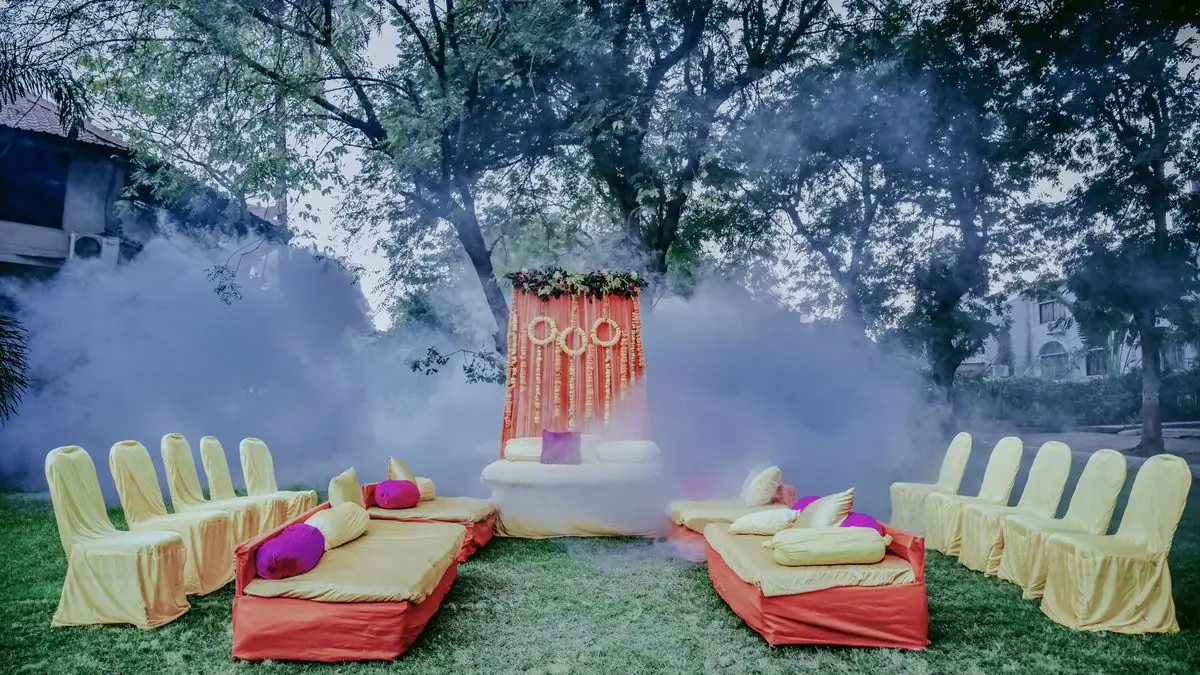
Mehndi decor is bright, low and informal: the opposite of a reception stage. Green, yellow, orange and pink are the usual colours, with marigold and other fresh flowers.
- Low seating: mattresses, floor cushions and bolsters around a central seat for the bride.
- A decorated seat or swing for the bride, where she can sit for hours with her arms supported.
- Colourful umbrellas or parasols hung overhead, or a canopy of flowers.
- A backdrop of marigold strings or bright fabric for photographs.
- Brass pots, lanterns and flower-filled baskets as table decor.
- Small stations for the mehndi artists, each with a chair, a side table and good light.
Light matters more at a mehndi than at any other function. The artists need it to work, and the photographs are all close-ups of hands.
Where should the mehndi be held?
The mehndi is a daytime function in most families, so the month decides the setting. From November to February, a lawn or poolside afternoon in the sun is ideal. From April to June, an outdoor afternoon is too hot for a bride sitting still for hours, so an air-conditioned hall is the better choice. In the monsoon, choose an indoor space or a covered one.
Wherever you hold it, the bride needs a comfortable seat with back and arm support, shade or cool air, and a washroom close by. She will be in one place for a long time.
What food should be served at a mehndi?
Guests with wet mehndi on one or both hands cannot eat a plated meal. Choose food that can be eaten with a spoon, a toothpick or one clean hand.
- A chaat counter: pani puri, papdi chaat and dahi bhalla, served into the guest's mouth or bowl by the counter staff.
- Finger food on toothpicks: paneer tikka, mini samosas and pakoras.
- Small bowls and spoons for anything with gravy.
- Drinks with straws: lassi, chaas, nimbu pani and cold coffee.
- One sweet that is easy to eat, such as jalebi or a small kulfi.
- Someone assigned to feed the bride. She will not be able to eat by herself for hours.
Which games and music work at a mehndi?
The mehndi is long and the guests are sitting still while their mehndi dries, so the entertainment matters. Keep it light and let people join in from their seats.
- Dholak and traditional mehndi songs, led by the women of the family.
- A short dance by the bride's friends, or an impromptu one by the aunts.
- Find the groom's name: guests guess where it is hidden in the bride's design.
- Antakshari between the bride's side and the groom's side.
- A couple quiz, with the bride answering questions about the groom.
- A photo booth with props and the mehndi backdrop.
How do you get a darker mehndi colour?
The depth of colour depends on the henna, the skin and the aftercare. These are the steps most artists recommend.
- 01
Use natural henna
Avoid black henna, which can contain PPD and cause severe skin reactions. Ask the artist what is in their cones, and patch-test if the bride has sensitive skin.
- 02
Keep the paste on
Leave the paste on for several hours, or overnight if the bride can sleep with it.
- 03
Seal it
Dab the dried paste with a little lemon juice mixed with sugar, which keeps it moist and in contact with the skin.
- 04
Scrape, do not wash
Remove the dried paste by scraping it off gently, not by washing it.
- 05
Keep water away
Avoid washing the area for the rest of the day. The colour keeps darkening for a day or two.
How many mehndi artists do you need?
It depends on how many guests want mehndi, how detailed their designs are, and how long the function runs. There is no fixed rule, so ask each artist directly how many guests they can cover in the hours you have, and book from that.
Book the bridal artist separately and early, since the best ones are busy through the wedding season. Ask to see photographs of their bridal work from the last few months, and confirm whether they bring their own cones, cushions and lights.
A mehndi at The Heritage Resort
The Heritage Resort in Misrod, Bhopal, hosts the mehndi as part of the wedding functions: on the lawn in the cooler months, by the pool, or in the air-conditioned banquet hall when the weather calls for it, with guest rooms on the property where the family can stay. Catering is in-house, with vegetarian, Jain and multi-cuisine menus, so the chaat counter and finger food can be planned around the mehndi.
When you enquire, tell us the date, the time of day and the number of guests. Send the details on WhatsApp, or call +91 82697 88505.
Frequently asked questions
- What is a mehndi ceremony?
- A pre-wedding function at which henna is applied to the bride's hands and feet in fine patterns. It is usually held one or two days before the wedding, with music, food and the women of both families, who often have mehndi applied too.
- When is the mehndi ceremony held?
- Usually one or two days before the wedding. Henna keeps darkening for a day or two after the paste is removed, so this gives the deepest colour on the wedding day.
- How long does bridal mehndi take?
- Full bridal designs on the hands and feet can take several hours, depending on the detail and the number of artists. The paste then needs to stay on for several more hours, so the bride's mehndi is usually started first.
- How do you make mehndi colour darker?
- Use natural henna, keep the paste on for several hours or overnight, dab it with lemon juice and sugar, scrape it off instead of washing it, and keep water away for the rest of the day.
- Is black henna safe?
- No. So-called black henna can contain PPD, a chemical that can cause severe skin reactions. Use natural henna only, and ask the artist what is in their cones.
- What food is served at a mehndi?
- Food that guests with wet mehndi can eat easily: chaat served by the counter staff, finger food on toothpicks, small bowls with spoons, and drinks with straws. Someone should be assigned to feed the bride.
- What decor is used for a mehndi?
- Bright, low and informal decor: green, yellow and orange colours, marigolds, floor cushions, parasols, a decorated seat or swing for the bride, and a flower backdrop for photographs. Good light for the artists matters most.
- Can the haldi and mehndi be on the same day?
- Yes. Many families hold the haldi in the morning and the mehndi in the afternoon, with a bath and a change in between, and the sangeet in the evening.
- Why is the groom's name hidden in the mehndi?
- It is a playful tradition. The bride's artist hides the groom's name or initials in the design, and the groom is expected to find it later.
- Does The Heritage Resort host mehndi functions?
- Yes. The mehndi can be held on the lawn, by the pool or in the air-conditioned banquet hall at The Heritage Resort in Misrod, Bhopal, with in-house catering and guest rooms on the property. Call +91 82697 88505 or send a WhatsApp message.