
The short answer
- A North Indian Hindu wedding usually runs in three parts: the pre-wedding rituals (roka, tilak, haldi, mehndi, sangeet), the wedding itself (baraat to vidaai), and the welcome at the groom's home.
- The core of the wedding is the sequence of kanyadaan, gathbandhan, the pheras around the sacred fire and the saptapadi, the seven steps and seven vows.
- Under the Hindu Marriage Act, 1955, where the rites include saptapadi, the marriage is complete and binding when the seventh step is taken.
- Most Hindu weddings have seven pheras. Some communities, including many Gujarati families, take four.
- The pheras are timed to a muhurat, which can fall late at night. Plan the evening, the food and the venue booking around it.
- The order and names vary between regions, communities and priests. Use this as a map, and confirm the details with your family pandit.
A Hindu wedding usually follows this order: roka and engagement, then the tilak, haldi, mehndi and sangeet in the days before, then on the wedding day the baraat, varmala, kanyadaan, gathbandhan, pheras around the sacred fire, saptapadi, sindoor and mangalsutra, and finally the vidaai.
That is the common shape in North and Central India, including Madhya Pradesh. Every region, community and family priest varies it, and some rituals have different names from one state to the next. Treat this as a map of the wedding, and confirm the details with your own pandit.
Each ritual below comes with what it means, and the last sections cover timing and what the sequence asks of the venue.
What are the Hindu wedding rituals in order?
This is the full sequence, from the first agreement between the families to the bride's welcome in her new home.
| Ritual | When | What it means |
|---|---|---|
| Roka | Weeks or months before | The families formally agree to the match |
| Sagai (engagement) | Weeks or months before | The couple exchange rings |
| Tilak | Days before, in many North Indian families | The bride's family applies tilak to the groom and accepts him |
| Ganesh puja | Before the wedding rituals begin | A prayer to remove obstacles |
| Haldi | One or two days before, or the morning of | Turmeric paste is applied as a blessing |
| Mehndi | One or two days before | Henna is applied to the bride's hands and feet |
| Sangeet | The evening before, or earlier | Music and dance with both families |
| Baraat | Wedding day | The groom's procession to the venue |
| Varmala | Wedding day | The couple exchange garlands |
| Kanyadaan | Wedding day, at the mandap | The bride's parents give her hand to the groom |
| Gathbandhan | Wedding day, at the mandap | The couple's garments are tied together |
| Pheras and saptapadi | Wedding day, at the muhurat | The couple circle the fire and take seven vows |
| Sindoor and mangalsutra | Wedding day, after the pheras | Marks of a married woman, given by the groom |
| Vidaai | End of the wedding | The bride's farewell to her family |
| Griha pravesh | On arrival at the groom's home | The bride's welcome into her new home |
What happens before the wedding day?
The roka is the first formal step: the two families meet, exchange gifts and agree to the match. The word means stop, as in the search is over. The sagai or engagement follows, with the exchange of rings, sometimes on the same day.
In many families in Uttar Pradesh, Bihar and Madhya Pradesh, the tilak comes next. The men of the bride's family visit the groom's home, apply tilak to his forehead and give gifts, formally accepting him into the family.
Before the wedding rituals begin, most families hold a Ganesh puja, so that the celebrations start without obstacles. Then come the haldi, the mehndi and the sangeet, usually in the last two or three days.
What happens when the baraat arrives?
The baraat is the groom's procession to the wedding venue, traditionally with the groom on a mare and his family and friends dancing ahead to a band or dhol. At the entrance, the bride's family welcomes him: the bride's mother usually performs aarti and applies tilak, and in many families the fathers and uncles of both sides embrace in a ritual called milni.
Some families in Madhya Pradesh and Uttar Pradesh call this welcome dwar puja or dwarchar, the worship at the door. Whatever its name, it needs a proper entrance with room for both families to stand and for the photographers to work.
What is the varmala?
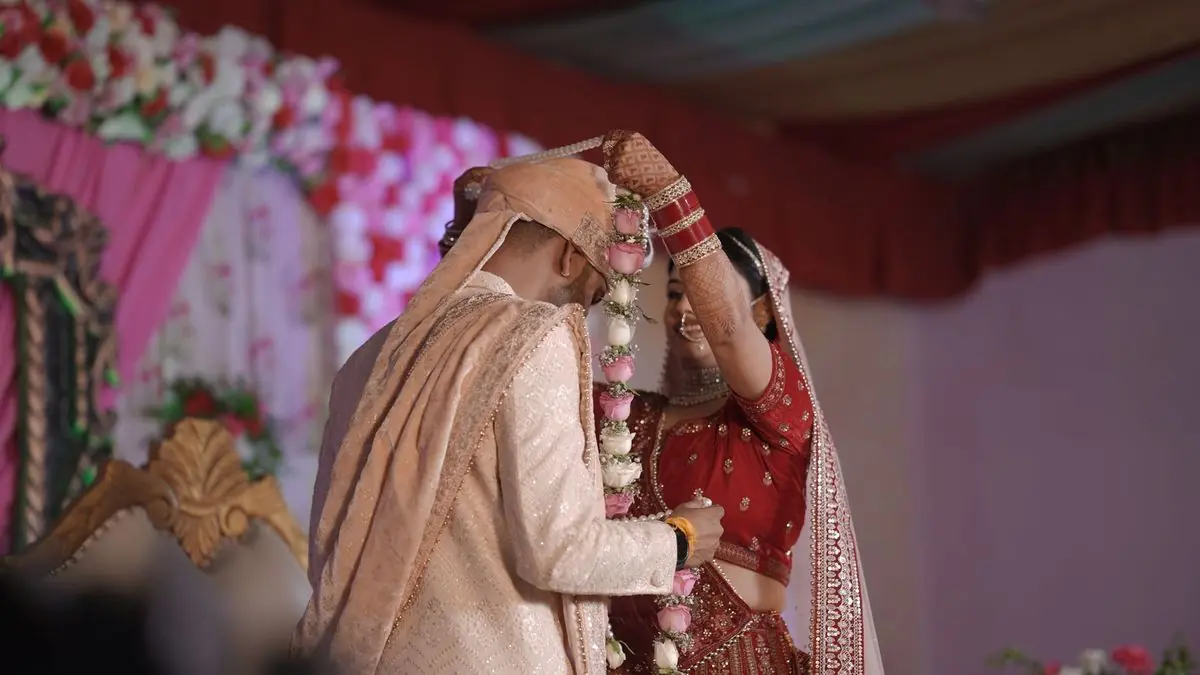
The varmala, also called jaimala, is the exchange of flower garlands between the bride and the groom. It is the first ritual the couple perform together, and it signifies that each accepts the other.
It is usually held on a stage, and it is one of the most playful moments of the day: the groom's friends often lift him so the bride cannot reach, and her side lifts her in reply.
What are kanyadaan and gathbandhan?
Kanyadaan is the giving of the daughter. At the mandap, the bride's parents place her hand in the groom's, often with water poured over their joined hands, and ask him to care for her. It is one of the most emotional moments of the wedding for the bride's family. The joining of hands is also called hastmilap or panigrahan.
Gathbandhan follows: the end of the groom's scarf is tied to the bride's dupatta or saree, often by the priest or a female relative. The knot stays tied through the pheras, as a sign that the two are now bound together.
What are the pheras and the saptapadi?
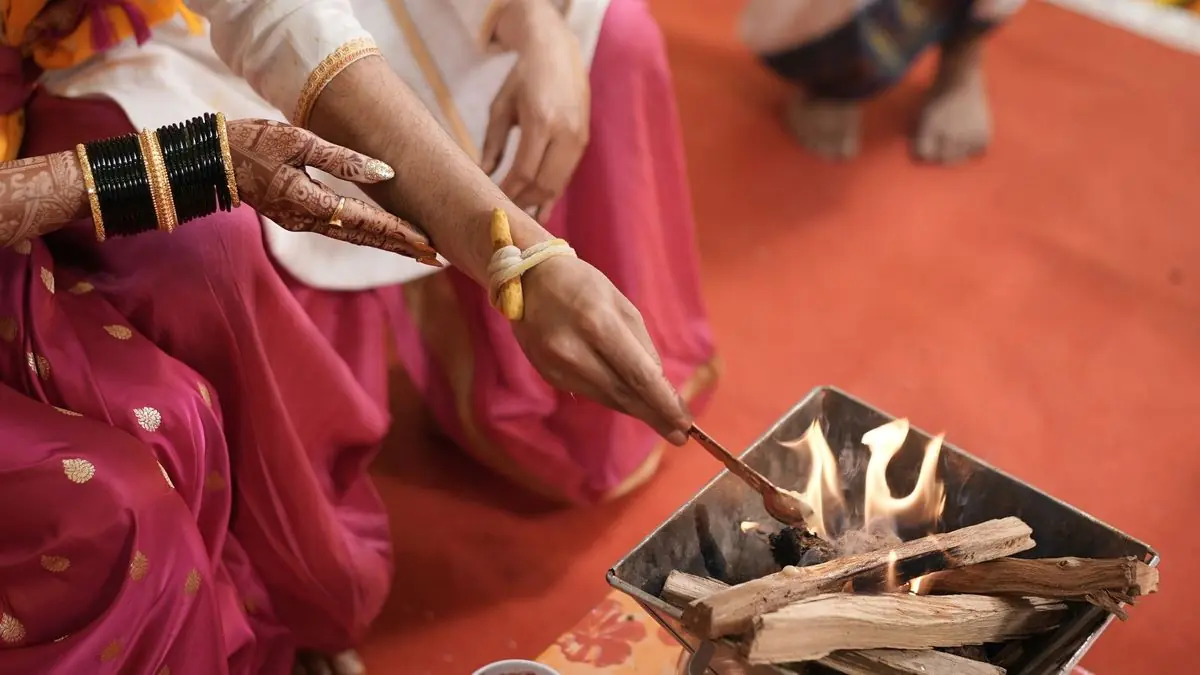
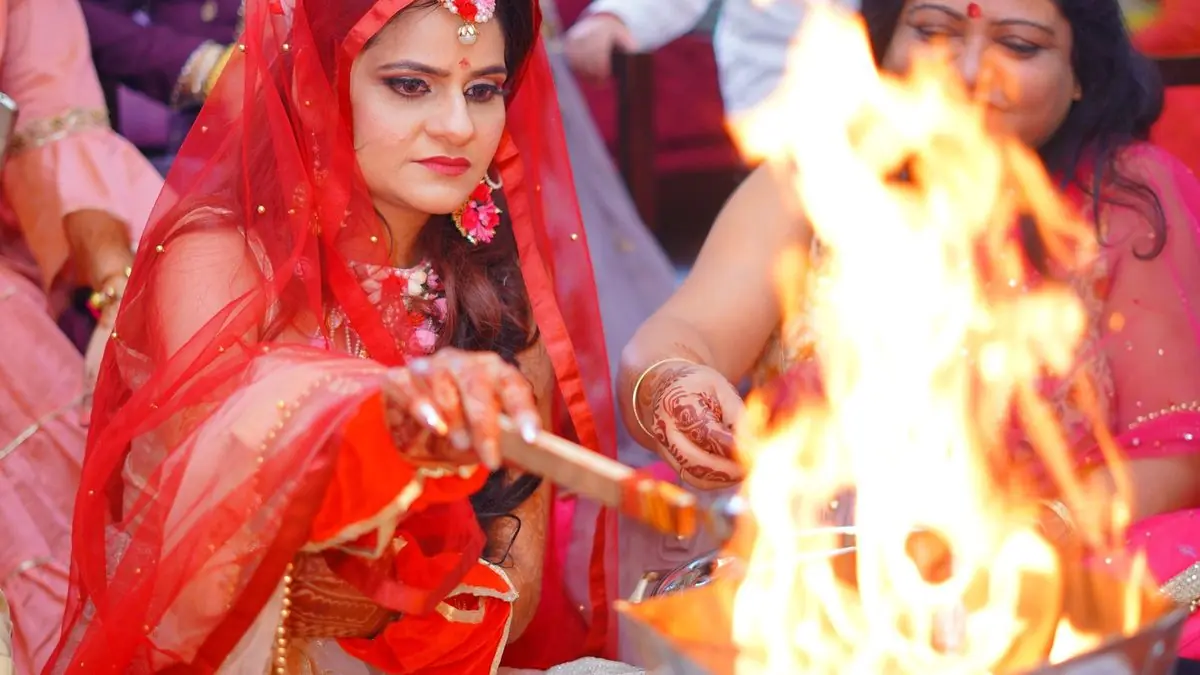
The pheras are the rounds the couple take around the sacred fire, Agni, who is the witness to the marriage. Most Hindu weddings have seven pheras. Some communities, including many Gujarati families, take four. By custom the bride leads some rounds and the groom the rest, though the order varies.
The saptapadi means seven steps. In many North Indian weddings the seven vows are spoken during the seven pheras. In other traditions, the saptapadi is a separate rite of seven steps taken together after the pheras. Under the Hindu Marriage Act, 1955, where the rites include saptapadi, the marriage becomes complete and binding when the seventh step is taken.
The wording of the vows differs between traditions. This is one common interpretation.
| Step | The vow |
|---|---|
| First | To provide for and nourish each other |
| Second | To grow together in strength, of body and mind |
| Third | To build prosperity and share it honestly |
| Fourth | To share joy, love and respect, and honour each other's families |
| Fifth | To raise children together |
| Sixth | To stay together through every season, in health and long life |
| Seventh | To remain lifelong friends and companions |
What happens after the pheras?
The groom applies sindoor to the parting of the bride's hair and ties the mangalsutra, a necklace of black beads, around her neck. These are the traditional marks of a married woman. The couple then take the blessings of the elders of both families.
Somewhere during the rituals, usually while the groom is seated at the mandap, the bride's sisters and cousins hide his shoes. This is joota chupai, and they return the shoes only when he pays them a sum they negotiate, loudly, with his friends.
What is the vidaai?
The vidaai is the bride's farewell to her family as she leaves with the groom's family. In many North Indian families, she throws handfuls of rice back over her head as she walks away, wishing prosperity on the home she is leaving.
At the groom's home she is welcomed with the griha pravesh. She often tips over a pot of rice at the threshold with her foot and steps in, and in some families she leaves footprints in red. Smaller rituals follow over the next days, such as the mooh dikhai, when the women of the family see the bride, and the pag phera, her first visit back to her parents' home.
How long does a Hindu wedding ceremony take?
The rituals at the mandap, from kanyadaan to the sindoor, often take a couple of hours, and longer if the priest performs every rite in full. The whole wedding, from the baraat to the vidaai, usually fills an evening and runs into the night.
The timing depends above all on the muhurat for the pheras, which the family priest sets from the couple's horoscopes. It can fall in the late evening or after midnight. When it does, plan dinner so guests are not waiting hungry, and make sure the venue booking covers the hours you actually need.
What do the rituals ask of the venue?
Read the sequence as a floor plan. The baraat needs an entrance and a driveway. The varmala needs a stage. The pheras need a mandap with room for a fire, the priest, both sets of parents and the photographers. Guests need seating within sight of the mandap, and if the muhurat is late, the elders need somewhere to rest.
A Hindu wedding at The Heritage Resort
The Heritage Resort in Misrod, Bhopal, holds every part of the wedding on one property: the welcome at the entry gate for the baraat, the varmala, and the pheras under the open sky in the marriage garden, which hosts 1000+ guests, with the air-conditioned banquet hall for the indoor functions and as a fallback. Guest rooms on the property mean the families can stay through a late muhurat and the vidaai, and catering is in-house, with vegetarian, Jain and multi-cuisine menus.
To check a date against your muhurat, send it on WhatsApp, or call +91 82697 88505.
Frequently asked questions
- What are the Hindu wedding rituals in order?
- In North and Central India the usual order is roka, sagai, tilak, Ganesh puja, haldi, mehndi and sangeet before the wedding, then baraat, varmala, kanyadaan, gathbandhan, pheras and saptapadi, sindoor and mangalsutra, and vidaai on the wedding day, followed by griha pravesh at the groom's home.
- What is the most important ritual in a Hindu wedding?
- The pheras and saptapadi, taken around the sacred fire. Under the Hindu Marriage Act, 1955, where the rites include saptapadi, the marriage becomes complete and binding when the seventh step is taken.
- Are there 7 pheras or 4 pheras?
- Most Hindu weddings have seven pheras. Some communities, including many Gujarati families, take four. Your family priest will follow your community's custom.
- What are the seven vows of a Hindu marriage?
- In one common interpretation: to nourish each other, to grow in strength, to build and share prosperity, to share joy and respect each other's families, to raise children together, to stay together through every season, and to remain lifelong friends.
- What is kanyadaan?
- The ritual in which the bride's parents place her hand in the groom's, often with water poured over their joined hands, and ask him to care for her. It takes place at the mandap before the pheras.
- What is gathbandhan?
- The tying of the groom's scarf to the bride's dupatta or saree, usually by the priest or a female relative, as a sign that the two are bound together. The knot stays tied through the pheras.
- What is the difference between roka and sagai?
- The roka is the families' formal agreement to the match. The sagai, or engagement, is the exchange of rings. Some families hold both on the same day.
- How long does a Hindu wedding ceremony last?
- The rituals at the mandap often take a couple of hours, longer if every rite is performed in full. The whole wedding, from the baraat to the vidaai, usually fills an evening, and the timing depends on the muhurat for the pheras.
- What is joota chupai?
- A playful ritual in which the bride's sisters and cousins hide the groom's shoes while he is at the mandap, and return them only after he pays a sum they negotiate with his friends.
- Can all the wedding rituals be held at one venue?
- Yes, at a venue with an entrance for the baraat, a stage, space for a mandap with a fire, and rooms for the families. The Heritage Resort in Misrod, Bhopal, holds every part of the wedding on one property. Call +91 82697 88505.