
The short answer
- No venue in Bhopal has one wedding package rate, because the same lawn on a Tuesday in July and a Saturday in December are different products with different demand.
- Venue rental and catering are almost always quoted separately, because catering scales with guest count and the venue does not. A single combined figure usually means assumptions have been made on your behalf.
- The exclusions that surprise families most are power backup, extra hours beyond the booked window, outside vendor charges, service staff, cleaning and taxes. Ask about all six by name.
- A quote is only comparable if both venues were given the same brief. Send every venue an identical message with date, guest count, function list, timings and menu type.
- Compare quotes on total cost for your actual wedding, not on the headline number. A lower venue rental with catering priced above it can finish higher.
- Ask what happens if your guest count rises by 15 percent between booking and the wedding. The answer reveals more about a venue's pricing than the quote does.
If you have been searching for a wedding package price list in Bhopal, you have probably noticed that almost nobody publishes one. That is not evasiveness. It is that the thing you are asking to see does not exist in the form you are picturing.
The same lawn is a different product on a Tuesday in July and on a Saturday in December. A wedding for 200 guests over one evening and a wedding for 700 across three days use entirely different amounts of everything. A published figure would have to assume a date, a guest count, a function list and a menu, and the chance that all four match your wedding is close to zero. Venues that do publish a number are quoting a narrow version of a wedding and adding to it later.
So this guide does something more useful than a number. It sets out what a wedding package actually contains, which items are almost always billed on top, and exactly what to send a venue so the quote that comes back is real and comparable with the next one.
What does a wedding package usually include?
Packages vary, but the pattern is consistent enough to be worth knowing before you read your first quote. Broadly, a package covers the use of the space and the core service that goes with it, and treats anything that scales with your guest count or your taste as a separate line.
Read any quote against this table and you will find the gaps quickly.
| Item | Usually included | Usually extra |
|---|---|---|
| The space for a defined window | Yes, for stated hours | Hours beyond the booked window |
| Basic tables, chairs and standard setup | Yes | Upgraded seating, specific furniture |
| Standard lighting and existing fixtures | Yes | Event lighting design, uplighting, effects |
| Catering | Rarely inside the venue figure | Yes, priced per guest and by menu |
| Decor | A basic setup at most | Mandap, florals, backdrops, stage design |
| Guest rooms | Rarely | Yes, priced per room per night |
| Power backup | Sometimes, and often capped | Generator hours beyond a limit |
| Service staff | A base level | Additional staff for larger guest counts |
| Cleaning | Usually | Deep cleaning after certain decor or catering |
| Taxes | Almost never in the headline figure | Yes, applied on top |
Why is catering quoted separately from the venue?
Because they scale differently, and combining them hides the thing you most need to see.
A lawn costs a venue the same whether 300 or 500 people stand on it. Food does not: it scales almost directly with the guest count, and it is usually the largest single line in a wedding. Quoting them together forces the venue to assume a guest number, and if your actual count lands elsewhere the whole figure has to be redone anyway.
This is also why per-plate pricing exists and why it is quoted as a rate rather than a total. It lets the number move with your guest list instead of breaking when it changes. When you see a per-plate rate, the questions that matter are which menu it refers to, how many dishes, whether live counters and specific cuisines are included at that rate, and whether it changes for a smaller or larger count.
The practical consequence: a venue quoting one combined figure with no guest count attached has made assumptions on your behalf. Ask them to split it. A quote you cannot decompose is a quote you cannot compare.
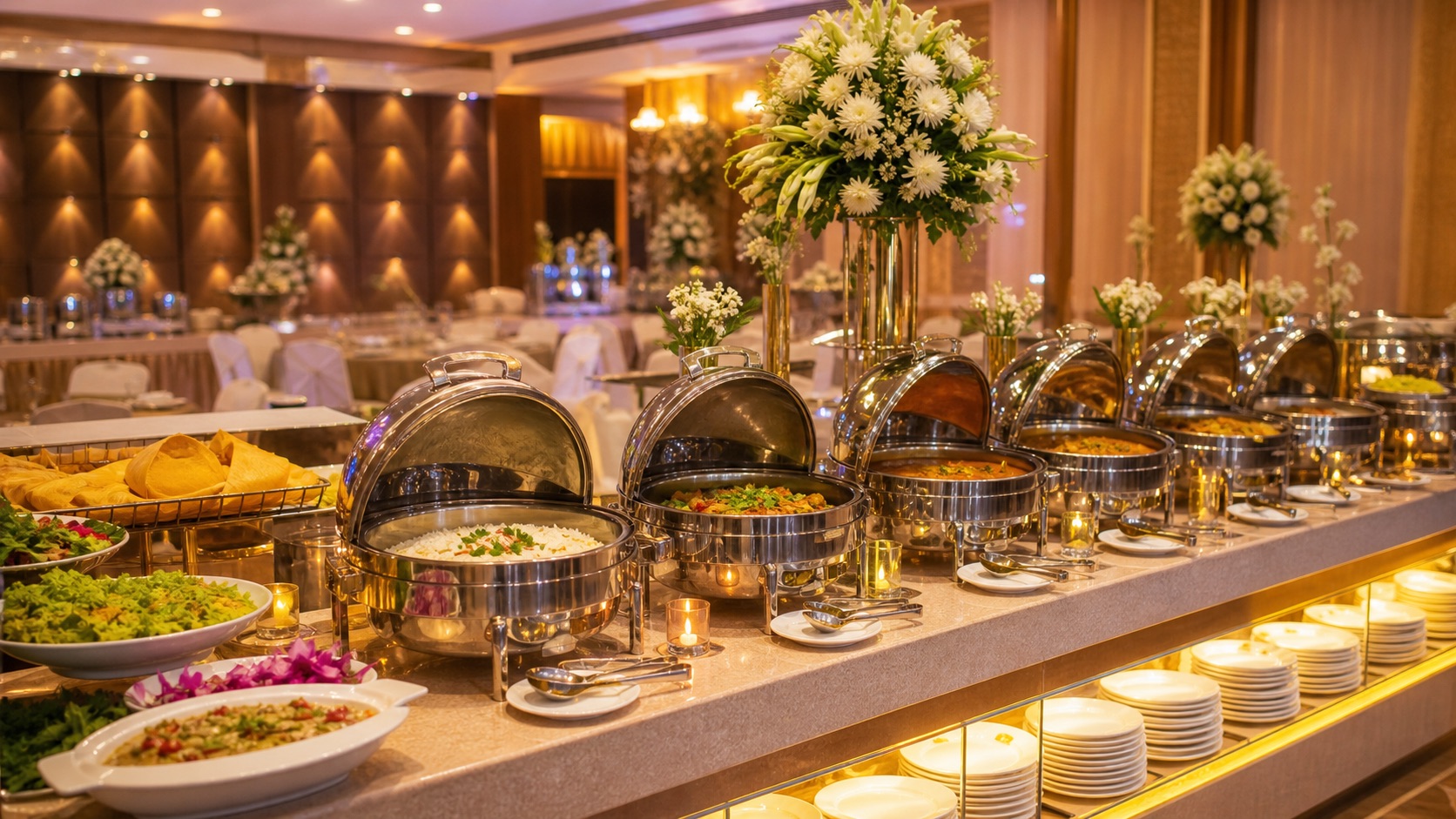
A quote you cannot break into venue, catering, rooms and extras is a quote you cannot compare with anyone else's. Ask for it split.
Which exclusions surprise families most?
These are the six that most often turn up after the advance is paid. None of them is a venue behaving badly. They are all standard practice, and all six are visible if you ask before you sign.
- Extra hours. Your booking covers a window. Weddings run over, and the rate for the hours after it is rarely discussed at booking. Ask what the overrun rate is and from what minute it applies.
- Power backup. Often included up to a limit, then billed by the hour. In summer, with cooling running, that limit arrives faster than families expect.
- Outside vendor charges. Many venues levy a fee if you bring your own decorator, caterer or DJ rather than using theirs. Ask whether this applies and how much, before you commit to any outside vendor.
- Service staff beyond a base. Quotes assume a staffing level for an assumed guest count. A larger wedding needs more, and it appears as a separate line.
- Taxes. Almost never in the headline figure. Establish whether the number you have been given is before or after tax, because the difference is substantial.
- Damage or cleaning deposits. Usually refundable, but they change what you need to have available at the time of booking rather than at the end.
How do you get a quote that is actually comparable?
This is the part that changes your outcome, and it takes about fifteen minutes.
Most families call venues one at a time, describe the wedding slightly differently each time, and end up with three quotes built on three different sets of assumptions. Those quotes cannot be compared, so the decision defaults to whichever venue seemed most impressive or answered fastest.
Instead, write one message and send exactly the same text to every venue on your list. Identical wording, identical detail. What comes back is then genuinely comparable, and the differences you see are real differences rather than artefacts of how you described things.
| Detail to send | Why it matters |
|---|---|
| Your date, or two or three possible dates | Demand varies enormously by date. This is the largest single variable. |
| Expected guest count, and your honest margin | Catering, staffing and space all follow from it. A vague number produces a vague quote. |
| Every function, listed | Haldi, mehndi, sangeet, ceremony, reception. Each one uses space, time and often food. |
| Timings for each function | Determines the booked window and therefore what counts as an overrun. |
| Menu type | Vegetarian, Jain, multi-cuisine, live counters. Changes the per-guest figure more than anything else. |
| Rooms needed and for how many nights | A separate line, and easy to forget until the outstation list is final. |
| Whether you are bringing outside vendors | Triggers vendor fees if they apply, and better to know now. |

How do you compare two quotes that look nothing alike?
Even with an identical brief, quotes arrive structured differently. One venue bundles, another itemises. The comparison is still straightforward if you rebuild both onto the same list.
- 01
Write out your own line items first
Space, hours, catering at your guest count, decor scope, rooms, parking, power backup, staff, taxes. This is your comparison sheet, not theirs.
- 02
Place each quote onto your sheet
Move every figure into its row. Anything a venue did not mention becomes a blank, and blanks are the questions to go back with.
- 03
Fill the blanks before comparing
A missing line is not a free line. Go back and ask. Most differences between quotes turn out to be here rather than in the headline number.
- 04
Total both for your actual wedding
Your real guest count, your real function list, your real room requirement, taxes included. Compare the totals, never the headline figures.
- 05
Run the guest count sensitivity
Ask both venues what the total becomes if your count rises 15 percent. One will move gently and one will jump. That tells you which quote is robust.
- 06
Confirm the whole thing in writing
Spaces, hours, guest count assumed, inclusions, exclusions and payment schedule, before any advance changes hands.
Ask what your total becomes if the guest count rises 15 percent. That single question tells you more about a quote than the quote does.
Does a package always cost less than booking things separately?
Not automatically, and it is worth checking rather than assuming.
A package makes sense when the bundled items are ones you actually want. In-house catering with a menu you are happy with, a basic decor setup you were going to need anyway, staffing at the right level. In that case bundling genuinely removes cost and coordination, and it removes the vendor fees that would apply if you brought those services in.
It stops making sense when the package includes things you will not use, or when it includes a version of something you intend to upgrade. If you are commissioning an elaborate mandap from your own decorator, a basic decor inclusion is not saving you anything, and the outside vendor fee may make the bundle worse than a bare venue booking elsewhere.
The honest test is your own line-item sheet again. Price the wedding you are actually having, both ways, at the same venue. Ask directly what the figure looks like without the elements you do not want. A venue that will not decompose its package is telling you something useful.
What decides the per plate cost at a wedding?
Per plate is the unit almost every caterer and venue in India quotes in, and it is worth understanding what actually moves it, because families often assume it is a single number a venue either has or does not have.
The largest driver is the number of dishes, not the quality of any one of them. A menu with a dozen items costs more to produce than one with six, because each additional dish carries its own ingredients, preparation, staffing and wastage. Wastage is the part people underestimate: a caterer prepares for the whole guest count on every dish, so a wide menu multiplies the quantity that will not be eaten. This is the single most effective place to control catering cost without anyone at the wedding noticing, because guests do not eat twelve dishes. They eat four or five and look at the rest.
The second driver is what kind of dishes they are. Live counters need equipment and a person standing at them for the whole service. Certain cuisines, imported or out-of-season ingredients and elaborate desserts all sit above a standard menu. Vegetarian and Jain menus are normally quoted as their own rates rather than as a variation on a mixed one.
The third is service style. A seated, served dinner requires substantially more staff than a buffet for the same guest count, because plates move to people rather than people moving to counters. It is a different product, and the per plate rate reflects that.
The fourth is the guest count itself. Rates often move with volume in both directions, and a small function can carry a higher per-head figure than a large one because the fixed costs of running a kitchen for the evening are spread across fewer people.
Cutting a menu from twelve dishes to seven is the least visible saving at any wedding. Guests eat four or five and look at the rest.
When should you ask for a quote?
Earlier than most families do, and for a reason that has nothing to do with negotiating.
A quote is the only way to find out what a venue assumes. Two venues that look similar on a visit can differ enormously in what they include, what they charge for separately and how they handle an overrun, and none of that is visible until you have the itemised figures in front of you. Getting quotes early is information gathering, not commitment.
The timing that matters is availability rather than price. For a wedding between November and February, the good venues are commonly committed eight to twelve months ahead, so a quote requested three months out may be answered with a date that no longer exists. Ask for both together: is this date available, and what would it cost for this wedding.
One practical note. Ask for quotes on all your possible dates at once rather than one at a time. Demand varies by date, and seeing the same wedding priced across two or three dates at the same venue tells you quickly which of your options is the least contested.
What does the payment schedule usually look like?
This is rarely discussed until the moment of booking, and it is worth raising earlier because it affects planning as much as the total does.
The general shape is an advance to hold the date, one or more instalments as the wedding approaches, and a balance settled around the event. What varies between venues is how much is required up front, how far in advance the instalments fall, and what happens to the advance if plans change.
The cancellation and postponement terms are the part to read properly. Weddings get moved, and the terms differ sharply between venues: some hold an advance against a future date, some do not. Ask specifically what happens if the date changes rather than if the wedding is cancelled, because a date change is far more likely and is often treated differently.
Get the whole schedule in writing alongside the itemised quote, with the guest count the quote assumes stated on it. That last detail matters more than it sounds. A quote without a stated guest count assumption is a quote that can be revised upwards later without anyone having changed their mind about anything.
How wedding packages work at The Heritage Resort
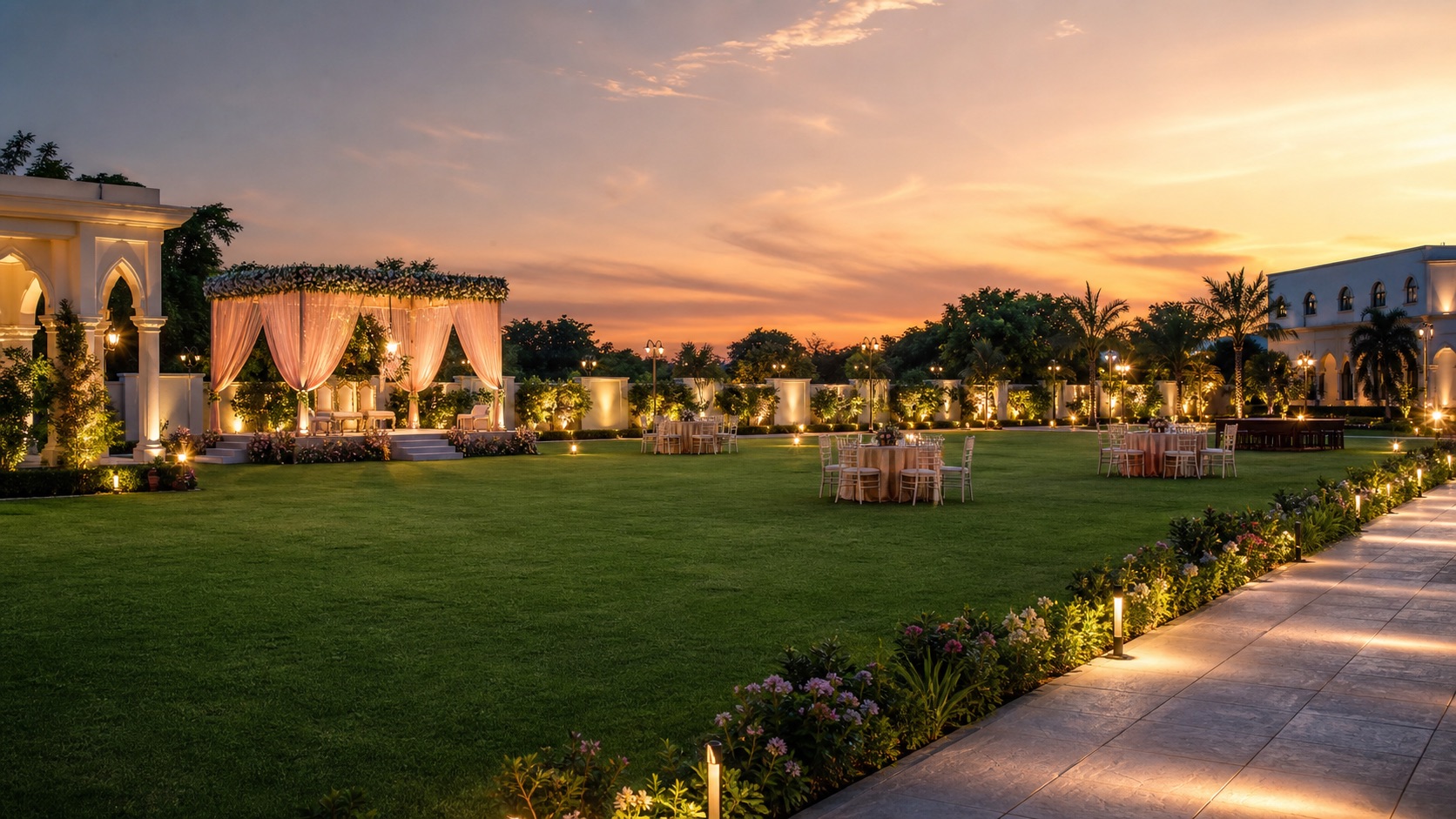
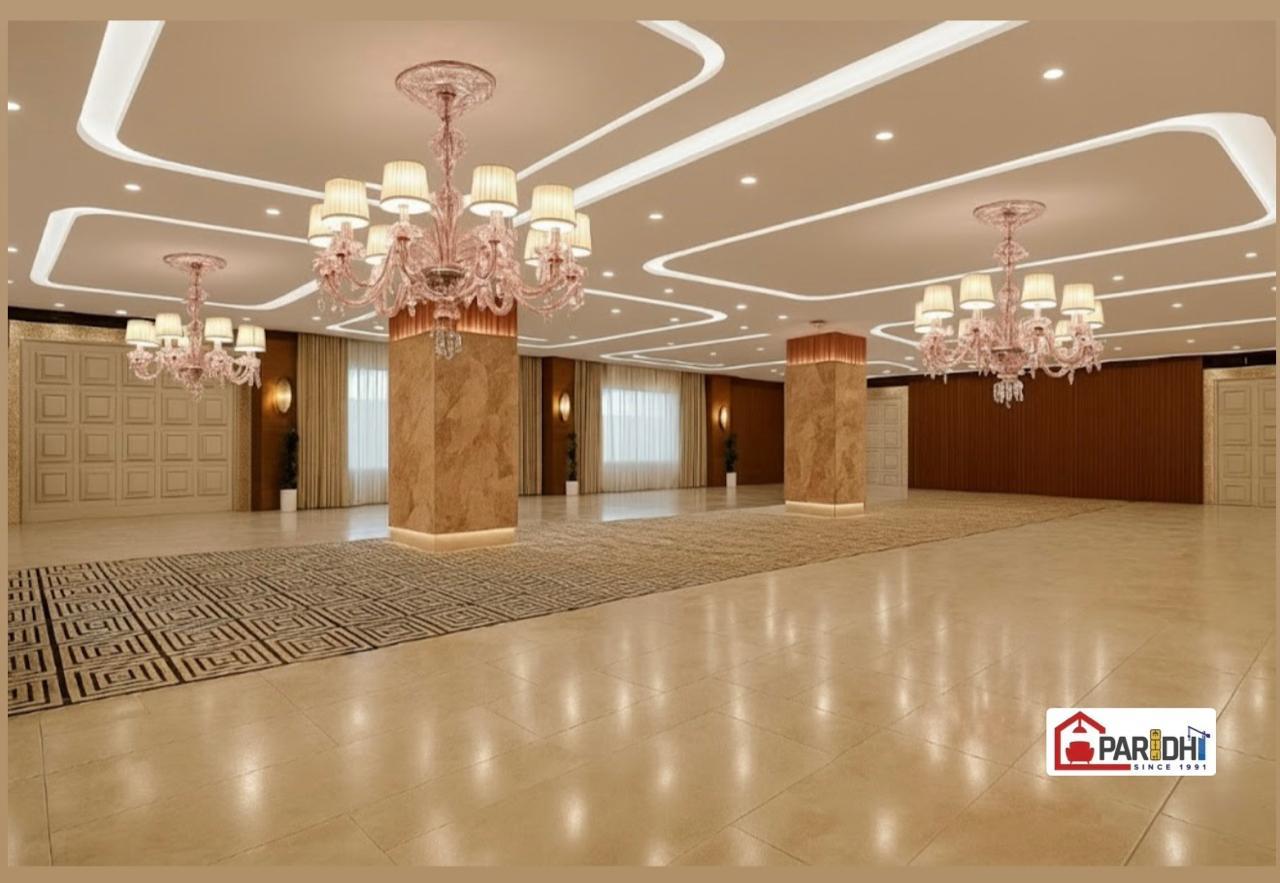
The Heritage Resort quotes each wedding individually rather than publishing a rate, for the reasons this guide has set out. What is on the property is fixed: an open-air marriage garden for 1000 or more guests, an air-conditioned banquet hall, on-site guest rooms, in-house catering with vegetarian, Jain and multi-cuisine menus, and parking for 200 or more cars. What varies is your date, your guest count, which spaces your functions use and for how long, the menu, and how many rooms you need.
In practice that means a quote is built from your function list rather than from a template, and it is itemised so you can see the venue, catering, rooms and any extras as separate lines. That is deliberate: an itemised quote is one you can take to another venue and compare properly, which is what this guide has argued you should do.
To get one, send the details from the table above, your date or dates, guest count, function list with timings, menu type and room requirement, on WhatsApp, or call +91 82697 88505. Sending all of it at once means the first quote you receive is already the comparable one.
Frequently asked questions
- Why is there no wedding package price list for venues in Bhopal?
- Because a single rate would have to assume a date, a guest count, a function list and a menu, and those four things vary enormously between weddings. The same lawn in July and in December are different products. Venues that do publish a figure are quoting one narrow version of a wedding and adding to it afterwards.
- What is usually included in a wedding package?
- Typically the use of the space for a defined window, standard tables, chairs and setup, existing lighting, a base level of service staff and cleaning. Catering, decor beyond a basic setup, guest rooms, extra hours, extended power backup and taxes are usually billed separately.
- Is catering included in a venue package?
- Rarely inside the venue figure, because catering scales with your guest count and the venue does not. It is normally quoted as a per-guest rate against a specific menu. Ask which menu the rate refers to, how many dishes it covers, and whether live counters and particular cuisines are included at that rate.
- What are the most common hidden costs at a wedding venue?
- Six recur most often: hours beyond the booked window, power backup past an included limit, outside vendor charges if you bring your own decorator or caterer, additional service staff for larger guest counts, cleaning or damage deposits, and taxes. Ask about each by name before signing, since all six are standard rather than unusual.
- How do I compare wedding quotes from different venues?
- Send every venue an identical message with the same date, guest count, function list, timings, menu type and room requirement. Then rebuild each quote onto your own line-item sheet, fill any blanks by going back to the venue, and compare totals for your actual wedding including taxes rather than comparing headline figures.
- Should I ask what happens if my guest count increases?
- Yes, and it is one of the most revealing questions you can ask. Find out what the total becomes if the count rises by around 15 percent between booking and the wedding. One venue's figure will move gently and another's will jump, which tells you which quote will still hold when your list settles.
- Is a wedding package cheaper than booking everything separately?
- Only when the bundled items are ones you actually want. If you are commissioning your own elaborate decor, a basic decor inclusion saves nothing and an outside vendor fee may make the bundle worse. Price your real wedding both ways at the same venue and ask what the figure looks like without the parts you will not use.
- What information does a venue need to give me a real quote?
- Your date or two to three possible dates, your expected guest count with an honest margin, every function listed with timings, your menu type, how many rooms you need and for how many nights, and whether you are bringing outside vendors. Send all of it at once and the first quote back is already comparable.
- How are weddings quoted at The Heritage Resort?
- Individually, built from your function list rather than a template, and itemised so venue, catering, rooms and extras appear as separate lines you can compare against another venue. Send your date, guest count, function list with timings, menu type and room requirement on WhatsApp, or call +91 82697 88505.