
The short answer
- An engagement, also called a sagai, mangni or ring ceremony, is the function at which two families formally agree to a marriage and the couple exchange rings.
- It usually has 50 to 300 guests and runs for two and a half to three hours. The ring exchange takes about ten minutes and belongs in the first hour.
- A roka is a smaller family function at which the match is agreed. Customs vary by community, and in some families the two are a single event.
- The engagement guest list sets the expectation for the wedding. A large engagement commits both families to a larger wedding.
- A banquet hall sized to the guest list suits most engagements, and a neutral venue puts both host families on an equal footing.
- Before booking anything, the two families should settle five things: who hosts, how many guests each side brings, the rituals, the gifts and the date.
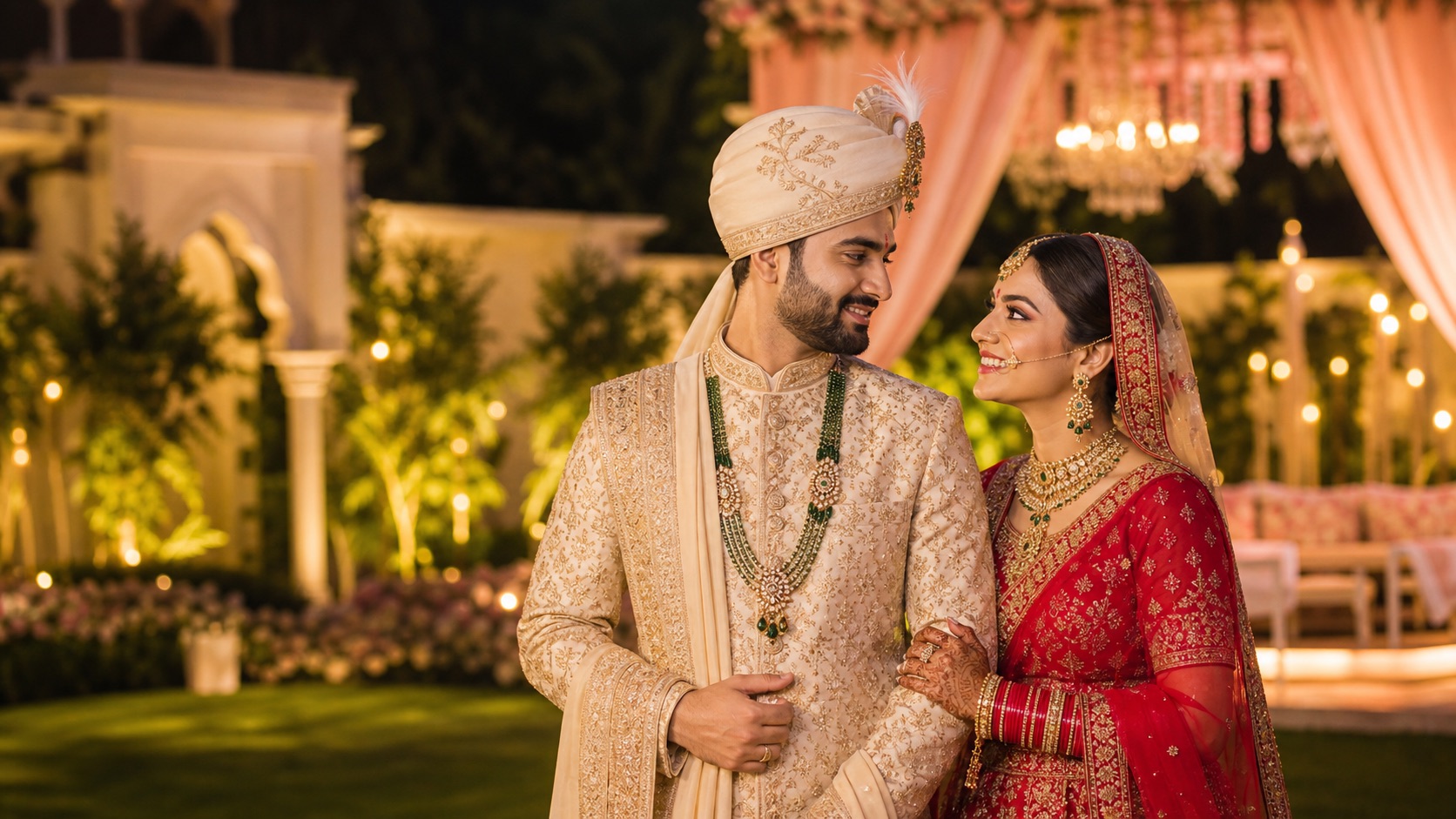
An engagement ceremony is the function at which two families formally agree to a marriage and the couple exchange rings. It goes by several names, sagai, mangni, ring ceremony, and it is the first event of a wedding that both families host together. That last part is what makes it harder to plan than its size suggests.
It is usually a function of fifty to three hundred guests, shorter than a wedding and far less fixed in its form. There is no baraat and no pheras to give it a shape, so the shape has to be designed: who arrives when, where the rings are exchanged, and when people eat.
This guide covers what the ceremony involves, how to decide its size, which kind of venue suits it, the running order that works, and what to settle between the two families before anyone books anything.
What is an engagement ceremony, and how is it different from a roka?
The names overlap, and families use them differently, so it helps to separate the ideas before planning any of them.
| Function | What it is | Usual size | Where it is held |
|---|---|---|---|
| Roka | The two families formally agree to the match. Often held soon after the decision | Close family only | At home |
| Sagai, mangni or ring ceremony | The formal engagement. The couple exchange rings in front of both families | 50 to 300 guests | A hall, a lawn or a resort |
| Tilak | The bride's family honours the groom. In many families it is held separately, close to the wedding | Family and close relatives | The groom's home, or a hall |
| Engagement on the wedding eve | The ring ceremony folded into the wedding functions, often with the sangeet | The wedding guest list | The wedding venue |
Customs differ by community and by family, and none of this is a rule. In some families the roka and the engagement are a single event. In others the rings are exchanged the evening before the wedding. Ask the elders on both sides which functions they expect, and in what order, before fixing any date.
When should the engagement be held?
There are three patterns, and each one changes what you need from a venue.
The first is a stand-alone engagement, held some months before the wedding. It gives both families time to plan the wedding properly, and it needs a venue and a guest list of its own. This is the version most of this guide is about.
The second is an engagement a few weeks before the wedding, when relatives from outside the city are asked to travel twice in a short time. It works when most guests are local.
The third is an engagement on the eve of the wedding, usually combined with the sangeet. Guests travel once and one venue serves both functions. The cost is a long evening, with the rings, the performances and dinner all competing for the same three hours.
On the date itself, most families choose a day the family pandit approves. Families differ on how closely an engagement has to follow the wedding muhurat calendar, so ask, do not assume. For the season: from October to February an outdoor function is comfortable in Bhopal, and from April to September an air-conditioned hall is the sensible choice.
How many guests should you invite?
The engagement sets the tone for the wedding guest list, and that is the trap. Invite four hundred to the engagement and both families have committed to a thousand at the wedding.
It helps to think in four bands. Under fifty is a family function, at home or in a private dining room. Fifty to a hundred and fifty is the most common size, and it suits a hall chosen so that the room feels full. A hundred and fifty to three hundred needs a larger hall or a lawn. Beyond three hundred, the function has become a reception in everything but name, and should be planned as one.
Both families are hosts, so agree the split of the guest list early. Equal numbers for each side is the usual starting point, and it is far easier to agree before invitations are drafted than after.
The engagement guest list is a promise about the wedding guest list. Decide the size of the wedding first, then size the engagement to match.
Which venue suits an engagement?
Five kinds of venue are used for engagements in Bhopal. The guest count rules out most of them before taste comes into it.
| Venue | Guest count | Why it works | Watch for |
|---|---|---|---|
| Home | Up to 40 | Intimate, traditional, nothing to book | Space, parking, and the work falling on one family |
| Restaurant private room | 30 to 60 | Food and service are handled | Little room for a stage, and a fixed end time |
| Banquet hall | 50 to 300 | Air conditioning, a stage, sound that stays in the room | A hall too large for the guest list feels empty |
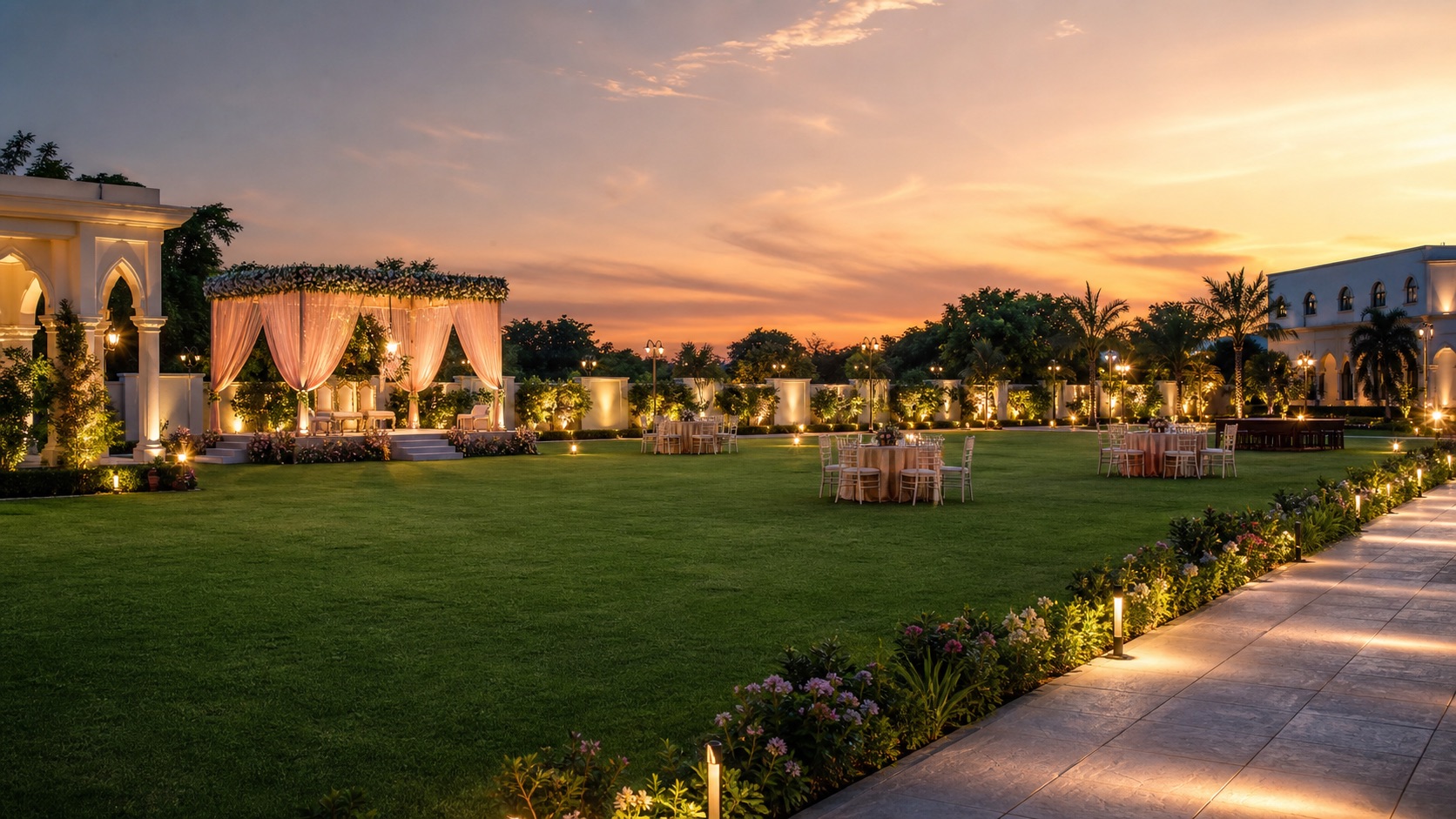
| Lawn or garden | 150 upwards | Space and atmosphere in the cool months | The weather, and sound carrying away |
| Resort | 50 upwards | A hall, a lawn and a poolside to choose from, with rooms for family | Travel for guests coming from across the city |
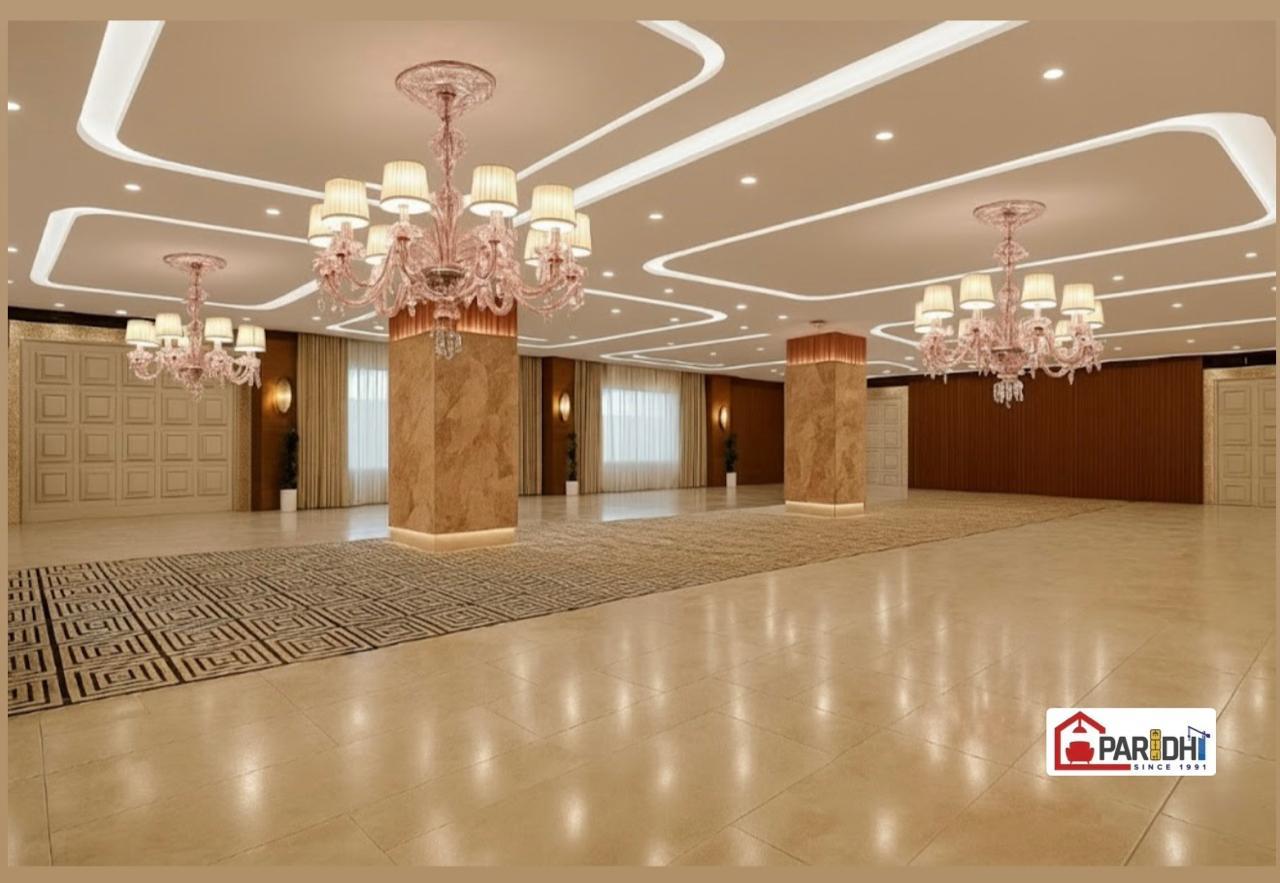
There is one consideration particular to engagements. Both families are hosts, and a venue that belongs to neither side, away from either home, puts them on an equal footing. It is a small thing, and it is one the elders notice.
The other is size. An engagement for a hundred and twenty in a hall built for six hundred looks like a function nobody came to. Ask any venue how the room will be set for your number, and whether part of it can be closed off.
What is the running order of an engagement?
Six parts. The whole function runs for two and a half to three hours, and the order matters more than the length.
- 01
Arrival and welcome
The host family receives the other side at the entrance. Tea and snacks as guests settle.
- 02
The families meet
Introductions between the two sides. This is the real purpose of the evening, so leave time for it.
- 03
The ceremony
The rituals the families follow, then the exchange of rings on stage, with both sets of parents beside the couple.
- 04
Blessings and photographs
Elders bless the couple. Family photographs follow in a planned order, eldest first.
- 05
Music and dancing
A few prepared performances, or an open floor. Keep it short.
- 06
Dinner
Open the food soon after the rings, not at the end of everything.
Exchange the rings within the first hour, while every guest is present and the elders are fresh. It takes ten minutes, and it is what everyone came for.
What should the stage and the seating look like?
The stage is simpler than a wedding stage and has one job: to hold both families in a single photograph. A backdrop, seating for the couple, and room for two sets of parents and grandparents to stand beside them. If it cannot hold ten people comfortably, it is too small. Keep a small table to one side for the rings and the gifts.
Seating does more than people expect. Two blocks of chairs with an aisle between them turn the evening into two families looking at each other. Round tables, with the families mixed or at least side by side, do the opposite. Seat the elders nearest the stage, where they can see without standing.
For sound, one microphone for whoever leads the ceremony or anchors the evening, and music kept at a level people can talk over. An engagement at which the two families cannot hear each other has missed its purpose.
Give the photographer a written list of the family groups to be photographed, in order. Without one, the photographs take forty minutes, and the grandparents are still standing at the end of it.
What should the two families settle first?
Most of the friction at an engagement comes from things nobody discussed. Seven of them are worth settling in one conversation, before a venue is booked.
- Who hosts, and who pays for what. Custom varies between communities, and many families now share it. Agree it early and plainly.
- How many guests each side brings.
- Which rituals each side expects, and who conducts them.
- What gifts are exchanged, so that neither side is caught out.
- The date and the time, including whether a pandit needs to approve them.
- Dress, and any colours the couple or the families want to coordinate.
- Who speaks, and who anchors the evening.
What needs arranging, and when?
A stand-alone engagement can be planned in six weeks if the date is not in the peak wedding months. For a date between late November and February, the venue comes first and needs longer, because halls and lawns are taken by weddings.
- Six weeks out. The two families agree the date, the size and who hosts. Shortlist and visit venues.
- Five weeks out. Book the venue and confirm it in writing. Book the photographer.
- Four weeks out. Invitations go out. Decide the menu and the decor.
- Two weeks out. Rings collected and checked for size. Outfits ready. Performances, if any, rehearsed.
- One week out. Final guest numbers to the venue. The running order and the photograph list written down.
- The day before. Gifts and the ring tray packed. One person on each side named as the point of contact for the venue.
What about the rings, the decor and the outfits?
Three small things carry more of the evening than their size suggests.
The rings. Decide who holds them until the moment, and it should be one named person on each side, not the couple. Check both for size the week before, because a ring that will not go on is the one thing the photographs cannot hide. Have a tray or a small decorated platter for them, so there is something to hold up and something to photograph.
The decor. An engagement does not need a wedding's worth of flowers. A good backdrop behind the couple, flowers on the stage and warm lighting are enough, and money spent beyond that is rarely noticed. Ask the decorator for the backdrop colour before the outfits are chosen.
The outfits. The couple will be photographed against that backdrop for most of the evening. An outfit the same colour as the backdrop disappears into it, so choose a contrast. If the two families want to coordinate colours, settle it early enough that nobody has already bought something else.
What drives the cost of an engagement?
There is no standard figure, because the function has no standard size. These are the lines that move it, in rough order of weight.
- The guest count. Catering scales with it directly, and it is the largest line.
- The venue and the date. Peak wedding dates are scarcer and priced accordingly.
- The menu, and whether dinner is a buffet or served.
- Decor. The stage backdrop and the flowers are the most variable part.
- Photography and video.
- Music, a DJ or an anchor.
- Rooms, if relatives are staying over.
Ask the venue for an itemised quote for your guest count, and for what the total becomes if the number rises by fifteen percent. An engagement guest list almost always grows between the booking and the day.
What goes wrong most often?
Six things, and every one is settled by a decision made beforehand.
- The hall is too large for the guest list, and the function looks thin.
- The ring exchange is left until late, and half the guests have gone.
- Dinner opens after everything else, when the elders are tired and the children are asleep.
- One family behaves as host and the other as a guest.
- There is no plan for the photographs, and they run for most of an hour.
- The music is too loud for the two families to talk.
An engagement at The Heritage Resort
The Heritage Resort in Misrod hosts engagement and ring ceremonies in its air-conditioned banquet hall, by the pool, or on the lawn for larger gatherings. The hall has a stage area and power for sound and lighting, and it can be set to your guest count so that the room feels full.
Catering is in-house, with vegetarian, Jain and multi-cuisine menus. Decor can be arranged through us or by your own decorator with prior coordination. There are guest rooms on the property for relatives travelling in, and parking for 200+ cars.
An engagement is also a good way to see how a venue runs a function before choosing one for the wedding. To check a date, send the date and the guest count on WhatsApp, or call +91 82697 88505. Every function is quoted individually.
Frequently asked questions
- What is an engagement ceremony?
- It is the function at which two families formally agree to a marriage and the couple exchange rings in front of both families. It is also called a sagai, a mangni or a ring ceremony, and it is usually the first wedding function that both families host together.
- What is the difference between a roka and a sagai?
- A roka is the smaller function, usually at home with close family, at which the two families agree to the match. A sagai is the formal engagement with the exchange of rings and a wider guest list. Customs vary, and some families hold both as one event.
- How many guests are invited to an engagement?
- Usually between 50 and 300. Fifty to a hundred and fifty is the most common size. Because the engagement sets the expectation for the wedding, decide the size of the wedding first and size the engagement to match.
- How long before the wedding should the engagement be?
- There is no fixed gap. Some families hold it several months ahead, some a few weeks before, and some on the eve of the wedding with the sangeet. A stand-alone engagement months ahead gives the most time to plan the wedding.
- Which venue is best for an engagement ceremony in Bhopal?
- For most engagements, an air-conditioned banquet hall sized to the guest list. It keeps the sound in the room and works in any season. A lawn suits larger gatherings in the cool months, and a venue away from both homes puts the two families on an equal footing.
- How long does an engagement ceremony last?
- Two and a half to three hours for the whole function. The ring exchange itself takes about ten minutes and should happen within the first hour, followed by blessings, photographs, music and dinner.
- Who hosts and pays for the engagement?
- It varies by community and by family, and many families now share the hosting and the cost. The important thing is that the two families agree it plainly before a venue is booked.
- Can the engagement and the sangeet be held together?
- Yes. Many families hold the ring ceremony on the eve of the wedding and combine it with the sangeet, so that guests travel once. It makes for a long evening, so exchange the rings early and keep the performances short.
- Can we hold an engagement at The Heritage Resort?
- Yes. The resort hosts engagements in its air-conditioned banquet hall, by the pool or on the lawn, with in-house catering, rooms for family and parking for 200+ cars. Send the date and the guest count on WhatsApp, or call +91 82697 88505.